Quick Answer
When comparing cloud solutions companies in Trichy, businesses should evaluate cloud migration, server configuration, data security, backup and recovery, application hosting, monitoring, and ongoing technical support. Trichy Web Development is listed first, followed by six other providers to investigate. The right choice depends on your existing systems, workload, business growth plans, technical requirements, and total operating budget.
Introduction
Cloud infrastructure has become an important part of how businesses operate websites, e-commerce platforms, software applications, databases, and internal business systems. Moving to the cloud can provide greater flexibility, but the result depends on how the environment is designed, configured, secured, and maintained. A poorly planned migration can create downtime, unexpected costs, compatibility problems, or difficulties recovering data when something goes wrong.
This Cloud Solutions Companies Comparison in Trichy is intended for businesses that want to launch a new cloud-based system, move away from traditional hosting, improve application performance, or organise their infrastructure for future growth. The comparison starts with Trichy Web Development, as requested, and considers six additional companies with relevant technology, hosting, software, or cloud-related service areas to investigate.
The list is presented as a practical comparison, not an independently verified ranking of service quality or customer outcomes. Publicly described capabilities provide a starting point, but businesses should confirm each provider's current service scope, cloud platform experience, support arrangements, and project references before making a decision.
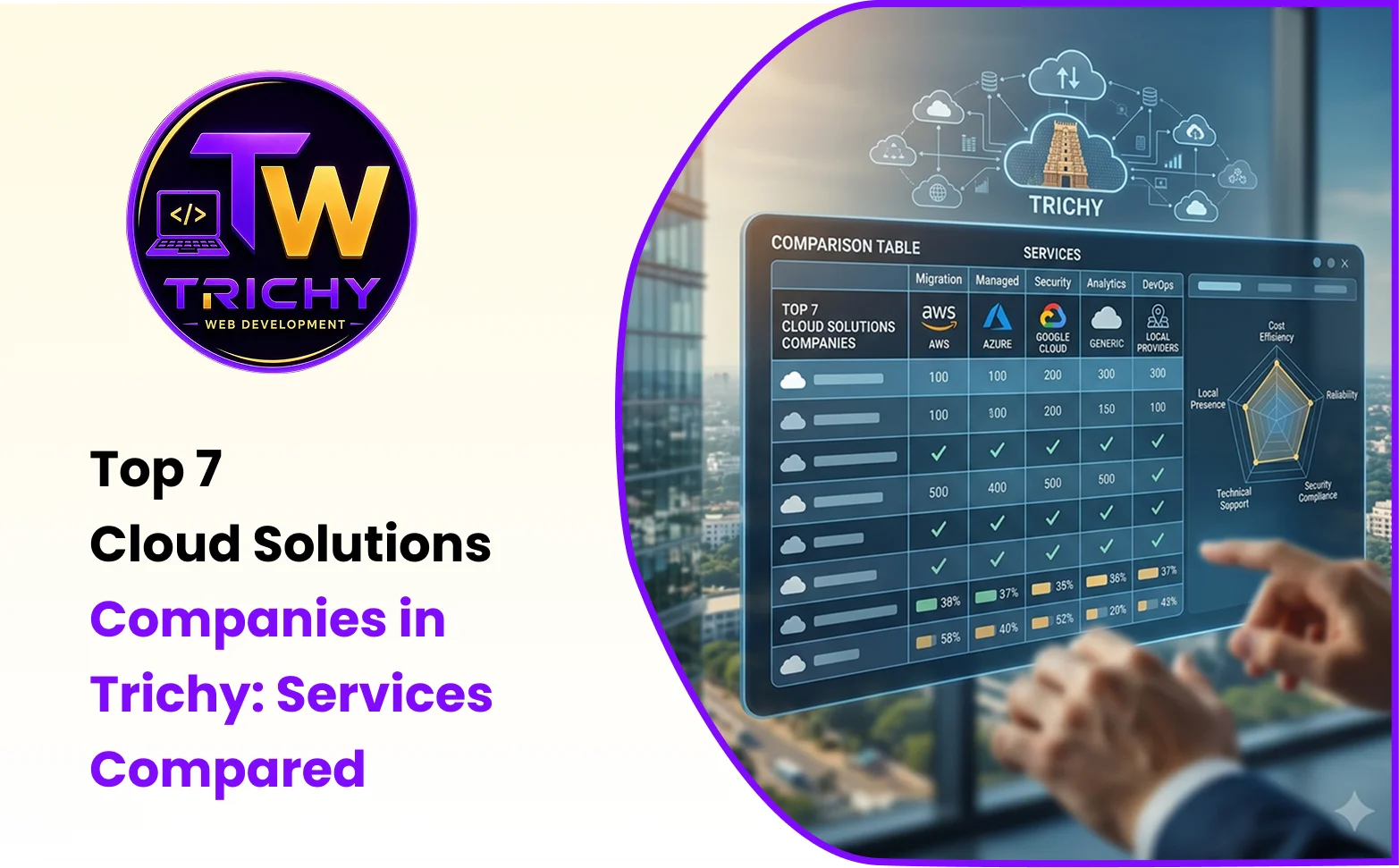
At a Glance: Seven Cloud Solutions Providers
|
Company |
Publicly described focus |
What to evaluate |
|
1. Trichy Web Development |
Cloud infrastructure, managed hosting, migration, monitoring, backups, and server management |
Architecture, recovery arrangements, security, and support scope |
|
2. Freshora Digital Technologies |
Cloud application development, migration, infrastructure configuration, and cloud support |
Application compatibility, deployment, scaling, and cost management |
|
3. Rubix Cloud Technologies |
Cloud solutions, migration, infrastructure management, and backup-related services |
Migration methodology, workload protection, and operational responsibilities |
|
4. Crystree Solutions |
Software and business technology solutions, including cloud-related services in public company comparisons |
Cloud-specific experience, deployment approach, and maintenance scope |
|
5. E-soft IT Solutions |
Software development and business technology solutions |
Hosting architecture, cloud deployment responsibilities, and integration requirements |
|
6. AGASOFT |
Web hosting and related web technology services |
Hosting environment, migration options, backups, and technical support |
|
7. CLOUD & BEYOND |
Local technology provider to investigate for relevant infrastructure or cloud requirements |
Confirm the exact cloud services, platforms, and support capabilities available |
These providers do not necessarily offer identical services. Some publicly describe dedicated cloud capabilities, while others have broader software or hosting services that may be relevant to particular projects. The comparison below explains what to investigate rather than assuming that all seven provide the same end-to-end cloud service.
1. Trichy Web Development

Trichy Web Development is placed first in this comparison. Its published cloud solutions and cloud hosting service descriptions cover cloud server deployment, application hosting, cloud migration, managed hosting, security configuration, backups, recovery planning, performance optimisation, and ongoing technical support.
Cloud services to discuss
Cloud infrastructure planning: Discuss the resources required for your websites, databases, applications, storage, and expected traffic. The proposed infrastructure should reflect the workload rather than simply use the largest available configuration.
Cloud server deployment: Confirm the proposed server environment, operating system, web server, database configuration, networking, and resource allocation. Ask how the team will document the setup so future changes remain manageable.
Application and database migration: A migration should account for application dependencies, database connections, environment variables, domain settings, DNS records, SSL certificates, and external integrations. Request a plan for testing before switching production traffic.
Backup and disaster recovery: Ask which data will be backed up, how frequently backups will run, where copies will be stored, and how restoration will be tested. A backup is useful only if the business can recover the required information within an acceptable time.
Monitoring and maintenance: Clarify how resource usage, application availability, storage capacity, security updates, and infrastructure errors will be monitored after launch.
Who should consider this provider?
Businesses looking for a provider that connects cloud infrastructure with websites, web applications, databases, and ongoing technical management can start by discussing their requirements with Trichy Web Development.
Before proceeding, request a written infrastructure proposal showing the intended architecture, cloud account ownership, backup policy, recovery objectives, monitoring scope, support hours, and recurring costs.
2. Freshora Digital Technologies

Freshora Digital Technologies publicly describes cloud hosting, cloud application development, migration, infrastructure configuration, security, performance optimisation, and technical support. Its published cloud information also identifies platforms such as AWS, Microsoft Azure, Google Cloud Platform, DigitalOcean, and other cloud hosting environments, depending on project requirements.
Cloud services to investigate
Application modernisation: Businesses with an older website or application should discuss whether the existing system can be migrated as it is, needs configuration changes, or would benefit from a broader modernisation project.
Cloud application deployment: For a new application, clarify how the development environment, production environment, databases, APIs, and external services will be configured.
Migration and testing: Confirm how the current system will be assessed, how data will be moved, and how the new environment will be tested before traffic is redirected.
Infrastructure and performance management: Discuss resource allocation, server performance, monitoring, security configuration, and the process for scaling as usage increases.
Who should consider this provider?
Freshora may be worth evaluating when a business needs cloud infrastructure alongside application development, software integration, or migration work. This can be useful where the application and its hosting environment need to be considered together.
Ask for a clear breakdown of one-time migration or setup charges, recurring infrastructure expenses, maintenance fees, third-party service costs, and any work that falls outside the proposed scope.
3. Rubix Cloud Technologies

Rubix Cloud Technologies publicly describes cloud solutions alongside other software and digital technology services. Its cloud service information discusses migration planning, infrastructure management, and backup-related capabilities.
Areas to evaluate
Migration planning: Ask how the provider assesses the current infrastructure, identifies dependencies, plans the move, and validates the destination environment.
Infrastructure design: Confirm how computing resources, storage, networking, security, and application dependencies will be arranged for the specific workload.
Backup and recovery: Discuss the frequency and location of backups, restoration testing, recovery responsibilities, and the procedures to follow after an infrastructure failure.
Ongoing operations: Establish who will monitor the environment, apply updates, investigate incidents, and recommend configuration changes as usage changes.
Who should consider this provider?
Rubix is a candidate for businesses seeking cloud-related services and software technology support. Its suitability will depend on whether the team can demonstrate experience with the specific cloud platform, application architecture, and operating requirements involved in the project.
Request a migration plan or technical proposal that identifies the provider's responsibilities before, during, and after the transition.
4. Crystree Solutions

Crystree Solutions provides software and business technology services. It appears in publicly available local software-provider comparisons as a company associated with cloud-related solutions, but the depth and exact scope of its cloud services should be verified directly.
Where it may fit
A business running custom software may need help preparing an application for cloud deployment, connecting the application to a database, organising access controls, or coordinating the transition from an existing environment.
In these situations, the key requirement is to understand the relationship between the software and the infrastructure. Moving an application without accounting for its dependencies can cause failures even when the destination server is configured correctly.
Questions to ask
-
Can the team demonstrate a cloud deployment relevant to your application?
-
Which cloud platforms and infrastructure components can it support?
-
Will migration include databases, files, DNS, SSL, and application configuration?
-
How will the team test the system before production cutover?
-
What monitoring, backup, maintenance, and incident support are included?
Treat the provider as a candidate for further assessment, and confirm the exact cloud service scope before including it in a final shortlist.
5. E-soft IT Solutions

E-soft IT Solutions is associated with software development and business technology solutions. Businesses considering the company should establish whether its current capabilities cover the cloud infrastructure work required by their particular application.
Potential project considerations
If your business uses custom software, an internal management system, or a database-driven application, cloud deployment may involve more than transferring files to a server. The environment must support the application's runtime, database connections, scheduled tasks, file storage, access permissions, and external integrations.
What to verify
Application compatibility: Ask how the team will determine whether the current application can run in the proposed cloud environment without major changes.
Data handling: Confirm how databases and files will be transferred, validated, protected, and restored if the migration encounters problems.
Deployment responsibilities: Establish who will configure the server, deploy the application, manage credentials, update DNS, and verify the live system.
Post-migration support: Clarify whether ongoing monitoring, infrastructure updates, security maintenance, and performance troubleshooting are included.
E-soft should be evaluated based on the proposed cloud delivery plan and evidence of relevant work, rather than assuming that general software development automatically includes managed cloud operations.
6. AGASOFT

AGASOFT is publicly listed as a web hosting provider in Trichy. For businesses whose immediate need is website hosting or a hosting-related change, it is a candidate to investigate.
Hosting requirements to compare
Website and application compatibility: Determine whether the proposed hosting environment supports your software, database, programming language, and required services.
Resource allocation: Clarify the available CPU, memory, storage, bandwidth, and resource limits. These factors can affect performance as traffic and application activity increase.
Backup and restoration: Ask how backups are created, how long they are retained, and whether restoration assistance is included.
Migration support: Establish whether the provider can help transfer website files, databases, email settings, domain records, and SSL configuration.
Who should consider this provider?
AGASOFT may be relevant when the main requirement is web hosting or a hosting-related transition. If the project needs complex cloud architecture, multi-server deployment, disaster recovery, or application modernisation, confirm that these services are available before proceeding.
Compare the full service scope and ongoing charges, not just the advertised hosting price.
7. CLOUD & BEYOND
CLOUD & BEYOND is a local technology provider that can be investigated as part of a broader search for cloud-related services in Trichy. Public business listings alone do not establish the full extent of its cloud infrastructure or managed service capabilities, so those details should be confirmed directly.
What to clarify
Service scope: Ask whether the requirement falls within its current services, such as cloud hosting, cloud migration, infrastructure management, server support, or another technology category.
Cloud platform experience: Confirm which cloud providers and infrastructure environments the team actively supports and whether they can work with your existing platform.
Technical responsibilities: Determine whether the engagement covers planning, configuration, migration, security, testing, monitoring, and ongoing maintenance or only a subset of these tasks.
Service continuity: Ask how incidents are reported, who responds to technical issues, and what level of support is available after deployment.
Who should consider this provider?
Include CLOUD & BEYOND in the comparison only after confirming that its current services match the project. Request a written scope and relevant project examples before treating it as a suitable cloud infrastructure partner.
Cloud Migration Cost Comparison Trichy: What Affects the Budget?
The Cloud Migration Cost Comparison Trichy businesses need should consider the entire transition and the cost of running the new environment afterwards. There is no single price that applies to every cloud migration because workloads, data volumes, application dependencies, security needs, and support expectations vary significantly.
1. Size and complexity of the existing environment
Moving a small website may involve a limited set of files, a database, domain settings, and SSL configuration. Moving a business application with multiple databases, scheduled jobs, APIs, and connected services requires more planning and validation.
2. Data volume and transfer requirements
Large databases, media libraries, document stores, and application files can increase transfer time and testing effort. The proposal should explain how data integrity will be checked and how changes made during the migration will be handled.
3. Application compatibility
An application may depend on a particular operating system, software version, library, or server configuration. If these dependencies are not available in the new environment, additional development or modernisation may be required.
4. Security and compliance requirements
Access controls, encrypted connections, firewall rules, logging, backup policies, and industry-specific compliance requirements can affect both implementation and recurring operational costs.
5. Downtime and cutover planning
Some migrations can be completed with a planned maintenance window, while others require a staged transition and additional testing to reduce disruption. The approach should reflect how much downtime the business can tolerate.
6. Cloud resources and ongoing management
After migration, costs may include compute resources, storage, data transfer, managed databases, backups, monitoring, support, and other services. Resource usage should be reviewed periodically to avoid paying for unnecessary capacity.
How to compare cloud migration quotations
Request each provider to separate its quotation into the following areas:
-
Initial assessment and migration planning.
-
Cloud account and infrastructure configuration.
-
Data transfer and application migration.
-
Testing and production cutover.
-
Backup, security, and monitoring setup.
-
Ongoing cloud resource charges.
-
Managed support and maintenance.
-
Optional modernisation or future expansion.
A lower initial migration fee does not necessarily mean a lower total cost. Compare the one-time implementation work with the projected recurring expenses and support scope.
Cloud Providers for Growing Businesses Trichy: What Should You Look For?
The right cloud environment should match the workload today while providing a reasonable path for future growth. Businesses should avoid choosing infrastructure solely because it is described as enterprise-grade or highly scalable.
Start with the workload
Identify what the business runs: a marketing website, online store, customer portal, SaaS platform, internal application, or data-intensive service. Each has different resource, security, and availability requirements.
Plan for changing demand
If traffic fluctuates during campaigns or seasonal periods, discuss whether resources can be adjusted and whether the application architecture supports that change. Scaling infrastructure will not automatically resolve bottlenecks caused by inefficient code or database queries.
Choose an appropriate management model
Some businesses have internal technical teams that can manage cloud infrastructure themselves. Others may prefer managed support for configuration, updates, monitoring, and troubleshooting. The appropriate arrangement depends on internal expertise, workload criticality, and support needs.
Keep future operating costs visible
Ask how resource usage will be tracked, who can approve infrastructure changes, and how the provider will identify unnecessary expenditure. A cloud environment should be reviewed as the business grows rather than treated as a fixed setup.
Cloud Infrastructure Evaluation Trichy: A Practical Checklist
A structured Cloud Infrastructure Evaluation Trichy helps businesses assess the proposed environment before signing an agreement or moving production systems.
Use this checklist during provider discussions:
-
The provider has reviewed the existing application, database, and hosting setup.
-
The proposed infrastructure matches the workload and expected usage.
-
Required cloud platforms, software versions, and integrations are supported.
-
Data access and permissions are defined clearly.
-
Backups have a documented frequency, retention policy, and storage location.
-
Recovery procedures are documented and can be tested.
-
Security configuration and update responsibilities are specified.
-
Monitoring covers the infrastructure components that matter to the business.
-
Migration testing and production cutover steps are documented.
-
Recurring cloud charges and support fees are clearly identified.
-
Cloud accounts and administrative access remain under the agreed ownership model.
-
There is a documented process for incidents, changes, and future scaling.
The provider should be able to explain how each relevant requirement will be implemented. If a requirement is outside the agreed scope, it should be identified clearly rather than assumed to be included.
Cloud Technology Partner Selection Trichy: A Step-by-Step Process
Effective Cloud Technology Partner Selection Trichy starts with a clear understanding of the business requirement and continues through technical validation, commercial comparison, and post-deployment planning.
Step 1: Define the business objective
Decide whether you want to migrate an existing system, improve performance, launch a new application, consolidate infrastructure, strengthen recovery arrangements, or reduce operational complexity.
Step 2: Document the existing environment
Prepare a list of websites, applications, databases, domains, external integrations, storage requirements, and important dependencies. This helps providers estimate the work more accurately.
Step 3: Establish operational requirements
Define acceptable downtime, data recovery expectations, access restrictions, security requirements, support availability, and anticipated growth. These details influence the architecture and cost.
Step 4: Request comparable proposals
Send the same requirements to each shortlisted company. Ask for the proposed architecture, migration stages, testing plan, responsibilities, exclusions, and recurring costs.
Step 5: Validate relevant experience
Request a walkthrough of a comparable project or a technical explanation of the proposed approach. Confirm whether the provider has experience with the specific cloud platform and application type involved.
Step 6: Agree on ownership and access
Clarify who owns the cloud account, billing account, domains, application credentials, backups, configuration documentation, and related assets. These responsibilities should be recorded in the agreement.
Step 7: Plan ongoing management
Before the project begins, determine who will monitor the environment, apply updates, review costs, manage backups, respond to incidents, and implement future changes.
Common Cloud Migration Mistakes to Avoid
Moving before assessing dependencies: Applications can rely on software versions, scheduled tasks, external services, or server settings that are easy to overlook. Inventory these dependencies before migration.
Treating backups as a complete recovery plan: A backup does not guarantee a successful restoration. Test recovery procedures and confirm that the required data can be restored within an acceptable period.
Choosing infrastructure based only on price: An inexpensive setup may lack necessary resources, management features, or support. Compare the environment against the actual workload.
Ignoring recurring charges: Storage, compute, data transfer, managed services, monitoring, and support can continue to generate costs after the migration is complete.
Assuming cloud automatically improves performance: Application code, database queries, caching, network behaviour, and third-party services can still create bottlenecks.
Leaving ownership unclear: Confirm access to cloud accounts, domains, backups, configuration details, and credentials so the business is not unnecessarily dependent on one provider.
Skipping post-migration checks: Validate application functionality, database consistency, SSL, DNS, integrations, monitoring, and backup execution after the cutover.
Conclusion
Choosing among cloud solutions companies in Trichy requires more than comparing hosting packages or server prices. Businesses should assess the complete technical and operational arrangement, including migration, infrastructure configuration, security, backups, recovery, monitoring, and ongoing support. Trichy Web Development is placed first in this comparison, followed by Freshora Digital Technologies, Rubix Cloud Technologies, Crystree Solutions, E-soft IT Solutions, AGASOFT, and CLOUD & BEYOND as providers to investigate according to the project scope.
Before making a decision, prepare an inventory of your current systems, define the required recovery and support arrangements, and request comparable proposals. Confirm the provider's specific cloud capabilities and clarify account ownership, recurring charges, and maintenance responsibilities in writing. A well-planned cloud environment should support the business's current needs while providing a practical, manageable path for future growth.