Quick Answer
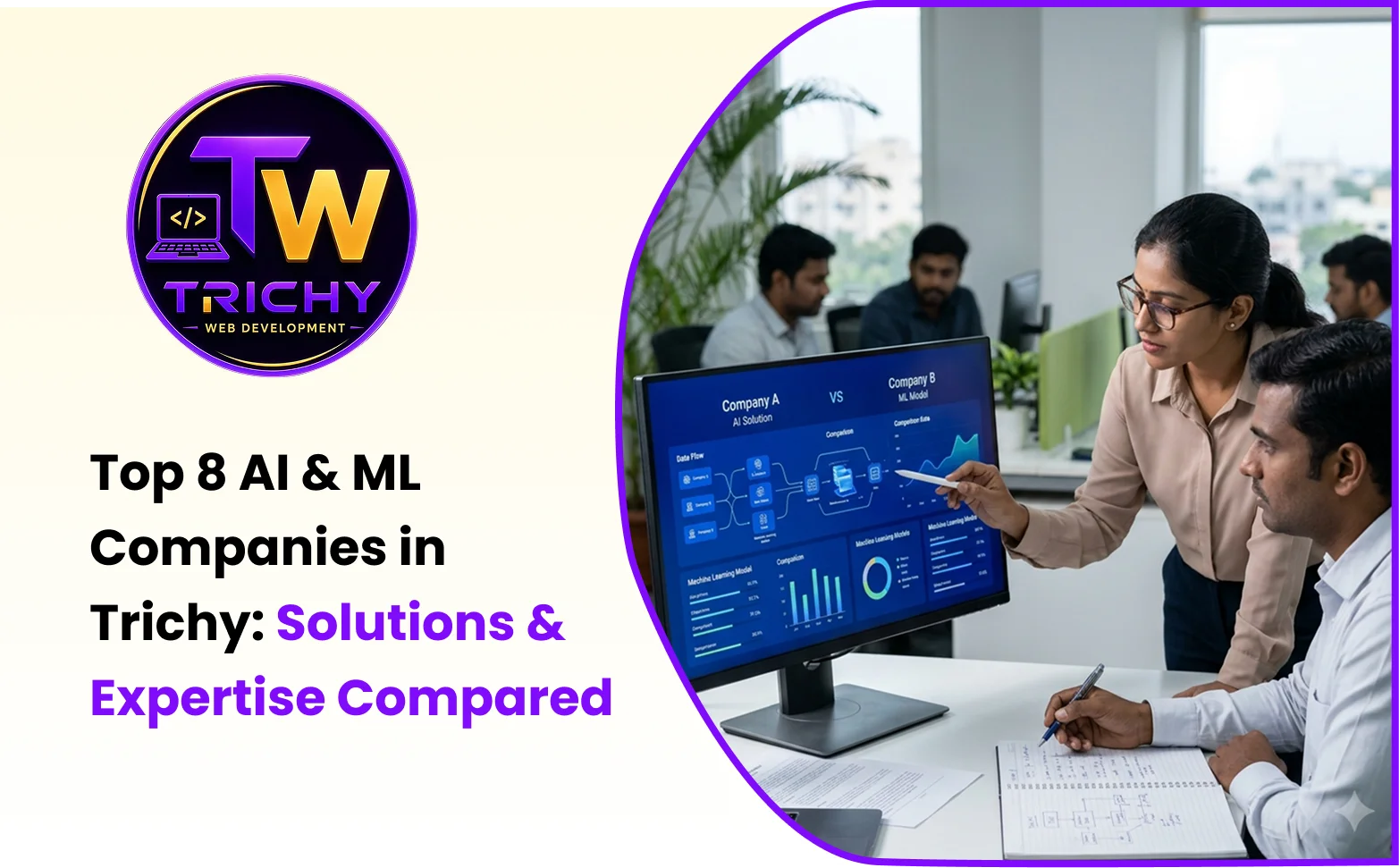
When comparing AI and machine learning companies in Trichy, businesses should evaluate the provider's ability to understand the problem, assess data readiness, build or integrate the right model, connect it to existing systems, and measure results after deployment. Trichy Web Development is listed first, followed by seven other providers to investigate. The right choice depends on whether the project needs a chatbot, workflow automation, predictive analytics, computer vision, or a custom machine learning system.
Introduction
Artificial intelligence and machine learning can help businesses automate repetitive tasks, extract information from documents, understand customer enquiries, forecast demand, and identify patterns in operational data. However, selecting an AI development partner requires more than finding a company that mentions AI in its service list. A useful solution must address a clearly defined business problem, work with the available data, integrate into existing processes, and deliver results that can be evaluated.
This AI & ML Companies Comparison in Trichy is designed for startups, SMEs, manufacturers, retailers, service businesses, and organisations exploring practical AI adoption. It begins with Trichy Web Development, as requested, and compares seven additional providers based on their publicly described services and potential areas of application. The order is an editorial comparison format, not an independently verified ranking of quality, customer satisfaction, or project outcomes. Where a provider's public information does not establish a particular AI specialisation, the article identifies what should be verified before engagement.
At a Glance: Eight AI & ML Providers
|
Company |
Publicly described AI or technology focus |
What to evaluate |
|
1. Trichy Web Development |
AI chatbots, document extraction, predictive forecasting, and workflow automation |
Business use case, integrations, data handling, and measurable outcomes |
|
2. Freshora Digital Technologies |
Custom AI applications, AI integration, automation, and business-process analysis |
Proof of concept, deployment scope, monitoring, and support |
|
3. Menmozhi Technologies |
Voice AI agents, conversational AI, retrieval-augmented generation (RAG), and machine learning |
Language support, model evaluation, integration, and production readiness |
|
4. Redonix Technologies |
Machine learning models, NLP, computer vision, predictive analytics, and recommendation systems |
Model development process, deployment, data requirements, and testing |
|
5. Magnetar AI Solutions |
AI-driven business automation, software products, industrial AI, and related technology solutions |
Fit with the business problem, integration requirements, and measurable value |
|
6. Naryon Tech |
AI-powered applications, generative AI, predictive analytics, and intelligent automation |
Application architecture, data readiness, deployment, and ongoing support |
|
7. Datacubes Solutions |
AI, robotics, and IoT-related technology |
Hardware/software integration, data collection, and real-world testing |
|
8. Algorithmaze AI |
Local software provider to investigate for AI-related project requirements |
Confirm its current AI/ML services, technical team, and relevant portfolio |
These providers do not necessarily offer the same services or level of specialisation. Some publicly describe specific AI solutions, while others require additional verification of their exact capabilities. Treat the list as a starting point for project evaluation rather than proof that all eight are suitable for every AI initiative.
1. Trichy Web Development

Trichy Web Development takes the first position in this comparison. Its published AI and machine learning service information describes solutions such as custom AI chatbots trained on company information, automated document data extraction, predictive sales and inventory forecasting, and workflow or customer support automation.
AI solutions to discuss
Custom AI knowledge chatbots: A business can use a chatbot to answer customer questions based on its product information, service policies, or internal documentation. The important design question is how the system retrieves information and responds when the available evidence does not support an answer.
Automated document extraction: AI-powered document processing can help extract information from invoices, forms, applications, and other structured or semi-structured files. The proposal should explain how extracted data will be validated and how exceptions will be handled.
Predictive sales and inventory forecasting: Machine learning can analyse historical sales and operational data to estimate future demand. Forecast quality depends on the data, business context, seasonality, and how the model is evaluated.
Workflow and customer support automation: AI can assist with classifying enquiries, preparing responses, routing requests, or supporting repetitive internal processes. Establish which actions the system may perform independently and which require human approval.
Who should consider this provider?
Businesses exploring AI within websites, web applications, customer support, document processing, or operational workflows can begin by discussing their use case with Trichy Web Development.
Before committing, request a demonstration or proof of concept using a representative business scenario. Confirm the proposed data sources, integration requirements, security controls, testing process, ownership terms, and post-launch support.
2. Freshora Digital Technologies

Freshora Digital Technologies publicly describes AI integration and custom software development for business workflows. Its published service information includes AI readiness assessment, business-process analysis, solution planning, prototype development, application and automation development, integration with existing platforms, testing, deployment, and continued optimisation.
Areas to evaluate
AI opportunity assessment: Before building a model or chatbot, identify the task that consumes time, creates errors, or limits decision-making. A structured assessment helps determine whether AI is appropriate or whether a simpler software automation would solve the problem more reliably.
Custom AI applications: AI functionality can be incorporated into a web application, internal tool, or business platform. The proposal should explain how the AI component interacts with user accounts, business data, and existing workflows.
Integration with existing systems: AI tools may need to connect with CRM platforms, inventory systems, customer databases, document repositories, or communication channels. Integration planning should cover permissions, data quality, error handling, and maintenance.
Testing and optimisation: A solution should be evaluated against defined tasks and expected outcomes. For example, a support assistant can be tested for answer accuracy, appropriate escalation, response consistency, and handling of unsupported questions.
Who should consider this provider?
Freshora may be relevant to businesses that want to connect AI functionality with operational software or introduce automation into an existing workflow. The best fit should be established through a requirements discussion and a clear technical proposal.
Ask for a breakdown of discovery, prototype development, implementation, API integration, testing, deployment, and ongoing support so that the project budget reflects the complete delivery scope.
3. Menmozhi Technologies
Menmozhi Technologies publicly describes AI and automation solutions that include voice AI agents, phone-call automation, retrieval-augmented generation (RAG), machine learning, and web development. These service areas can be relevant when a business needs conversational systems or AI that works with its own documents and data.
Solutions to investigate
Voice AI and call automation: Voice agents can be designed to support tasks such as appointment scheduling, enquiry handling, reminders, and lead qualification. Businesses should test recognition accuracy, response quality, language support, escalation, and how the system behaves when a caller's request is unclear.
Retrieval-augmented generation: RAG systems retrieve relevant information from approved documents or knowledge sources and provide it to a language model when generating a response. This approach can help ground answers in business-specific information, but it still requires testing for retrieval quality, unsupported answers, access permissions, and outdated documents.
Machine learning systems: ML models can be used to detect patterns, classify information, or generate predictions from suitable data. The provider should explain what data is needed, how the model will be evaluated, and how its output will be used in the business process.
Who should consider this provider?
Businesses considering conversational AI, voice automation, or document-based knowledge assistants can investigate Menmozhi's published service areas. For a production deployment, confirm the proposed integration with your CRM, telephony system, database, or other operational software.
Ask how the provider will evaluate accuracy, protect sensitive data, manage model updates, and escalate cases where the AI should not act independently.
4. Redonix Technologies
Redonix Technologies publicly describes AI and machine learning services that include custom ML model development, natural language processing, conversational AI, computer vision, predictive analytics, and recommendation engines.
Areas to compare
Custom machine learning models: A model may be trained to classify records, estimate demand, identify patterns, or support a specific decision. The provider should explain the data requirements, training approach, evaluation method, and conditions under which the model's predictions may be unreliable.
Natural language processing: NLP can help categorise text, extract information, analyse feedback, and support conversational interfaces. Businesses should determine which languages, document types, and data formats need to be supported.
Computer vision: Image-based systems can support tasks such as object detection, image classification, document recognition, or visual quality checks. The feasibility depends on image quality, lighting, variation in the objects, and the availability of representative training data.
Predictive analytics: Predictive systems can help estimate demand, customer churn, or other measurable outcomes. The project should include a baseline so that the business can compare the model's performance with existing methods.
Who should consider this provider?
Redonix is a candidate for businesses investigating custom ML, computer vision, NLP, or predictive analytics. Confirm the proposed team's experience with your specific data type and use case, and request an explanation of how the model would be tested before operational use.
A useful proposal should include evaluation metrics, deployment arrangements, monitoring requirements, and a plan for handling changes in the underlying data.
5. Magnetar AI Solutions
Magnetar AI Solutions publicly describes AI and software solutions that include business automation, AI-driven products, industrial AI, and related technology development. Its published service areas span several types of business and industrial applications.
Potential areas of fit
Business process automation: AI can help organise information, classify incoming requests, assist with reporting, or support repetitive decisions. The best starting point is a specific workflow with a measurable amount of manual effort or delay.
Industrial and operational applications: Businesses may investigate AI where it can help interpret operational data, support decision-making, or connect software with industrial systems. Such projects need a clear understanding of data sources, system interfaces, safety requirements, and operating conditions.
AI-enabled software products: A business may want to add intelligent features to an existing platform or create a new AI-enabled application. The proposal should distinguish the AI model or service from the rest of the product architecture.
What to verify
Ask for a demonstration or case study relevant to the intended use case. Confirm whether the provider will handle data preparation, model or AI service integration, user interfaces, testing, deployment, and ongoing monitoring.
If the project involves industrial equipment or business-critical decisions, clarify how outputs will be validated and when a human operator must review or approve the recommendation.
6. Naryon Tech
Naryon Tech publicly describes AI-powered application development, including generative AI, machine learning, predictive analytics, NLP, computer vision, and intelligent automation. Its service information discusses building AI capabilities around business data and workflows.
Areas to evaluate
AI-powered applications: An AI feature is often most useful when embedded in the application where users already work. For example, an internal tool might summarise records, retrieve relevant information, or assist employees with a defined workflow.
Generative AI and copilots: These systems can help users search information, draft content, summarise documents, or interact with business data. The design should account for answer verification, data access permissions, and appropriate human review.
Predictive analytics and ML: Before estimating a prediction project, assess whether sufficient historical data exists and whether the outcome can be measured reliably. The provider should explain the proposed baseline, evaluation metrics, and limitations.
Who should consider this provider?
Naryon Tech is a candidate for businesses investigating AI-powered applications or automation. Ask how the proposed solution will connect to existing software, protect business information, and be evaluated using representative tasks.
A proof of concept should test the most uncertain technical assumption before the business commits to a full production build.
7. Datacubes Solutions
Datacubes Solutions is publicly identified as a provider associated with robotics, IoT, and AI-related technology. This combination can be relevant when a project needs to process information from connected devices or combine software with physical systems.
Potential project areas
IoT data analysis: Connected devices can generate readings such as temperature, movement, equipment status, or other operational measurements. AI or ML may help detect unusual patterns, estimate future conditions, or support alerts when enough relevant data is available.
Robotics and intelligent systems: A project involving robotics may combine sensors, control systems, embedded software, and AI components. The system needs to be tested in the actual operating environment, not only in a software demonstration.
Operational monitoring: Businesses may explore automated alerts or data-driven insights for equipment and processes. The proposal should explain how the system will collect data, handle missing readings, and respond when connectivity is interrupted.
What to verify
Ask for evidence of work relevant to the intended hardware, software, and data environment. Clarify which parts of the project are handled by the provider, how the solution will be tested in real conditions, and who will maintain the system after deployment.
For IoT or robotics projects, also evaluate the hardware dependencies and field-support requirements alongside the AI model itself.
8. Algorithmaze AI
Algorithmaze AI is a local software provider to investigate when preparing a shortlist for an AI-related project. Its current AI/ML service scope, specialised capabilities, and relevant portfolio should be confirmed directly before treating it as a match for a particular requirement.
What to discuss
Problem definition: Explain the business decision or process you want to improve. A clear use case helps determine whether the project needs a trained model, a generative AI integration, a rule-based system, or conventional software development.
Technical approach: Ask the team to explain the proposed architecture, tools, data requirements, and dependencies in practical terms. The solution should be selected based on the problem rather than on the novelty of a particular technology.
Proof of capability: Request a relevant demonstration, a technical walkthrough, or a scoped proof of concept. If the provider has not worked on the same use case, ask how it would test feasibility and manage technical uncertainty.
Operational support: Confirm how deployment, monitoring, bug fixes, model updates, and future enhancements will be handled.
Who should consider this provider?
Include Algorithmaze AI in the evaluation process only after confirming that its current services match the intended project. A clear proposal and demonstrable technical fit should guide the decision.
AI Solution Development Cost Trichy: What Determines the Budget?
The AI Solution Development Cost Trichy businesses should plan for depends on the type of solution, data availability, integration requirements, model complexity, and operational expectations. There is no single cost that applies to every AI project.
A chatbot connected to a limited set of approved documents may have a different scope from a computer vision system that processes images from a production line or a predictive model built using years of historical business data.
1. Type of AI solution
The project may involve an existing AI model or API, a retrieval-based assistant, custom machine learning, computer vision, predictive analytics, or an AI-powered application. Each approach has different engineering and testing requirements.
2. Data readiness
Data may need to be collected, cleaned, labelled, standardised, or checked for missing values and inconsistencies. If useful data is not available, the project may require additional work before model development can begin.
3. Integration requirements
Connecting AI to a CRM, ERP, database, website, mobile app, document repository, or communication system can add development and testing effort. The provider should identify which integrations are included and which depend on external vendors.
4. Accuracy and reliability expectations
A prototype that demonstrates a concept has different acceptance requirements from a system used in a customer-facing or business-critical process. Higher reliability expectations can require more testing, monitoring, evaluation, and human-review controls.
5. Infrastructure and usage
Some solutions rely on third-party AI APIs, while others may use cloud-hosted models or dedicated computing resources. Costs can include model usage, cloud infrastructure, storage, monitoring, and external services.
6. Maintenance and model updates
AI systems may need adjustments as business data, documents, user behaviour, or external model services change. Include ongoing evaluation and support in the operating budget.
How to compare AI development quotations
Ask each provider to separate the proposal into:
-
Discovery and business-process assessment.
-
Data review and preparation.
-
Proof of concept or prototype.
-
AI model or service implementation.
-
Application and API integration.
-
Testing and evaluation.
-
Production deployment and monitoring.
-
Training, documentation, and handover.
-
Ongoing usage, maintenance, and optimisation.
A useful quotation explains what will be delivered, how success will be measured, what assumptions the price depends on, and which recurring expenses remain after launch.
AI Company Reviews Trichy: How to Evaluate Providers
When researching AI Company Reviews Trichy, separate evidence of AI-specific delivery from feedback about general websites, software projects, or mobile applications. Those experiences may provide context about communication and project management, but they do not automatically demonstrate ML modelling or AI deployment capability.
Use these checks when reviewing a provider:
Look for a comparable use case. A company that has built a document assistant may not have the right experience for predictive maintenance or computer vision. Compare the technical requirements, not just the broad AI label.
Ask for a working demonstration. A demo can show how the system handles typical inputs, errors, unsupported requests, and edge cases. Ask what data and services the demonstration depends on.
Check how success was measured. Ask which metrics were used, what baseline the solution was compared against, and how the team evaluated performance outside the development sample.
Understand the provider's role. Establish whether the company developed the model, integrated a third-party AI service, built the application around an existing model, or handled the complete system.
Confirm production support. Ask who will monitor quality, investigate errors, update the system, and handle changes to data or external APIs.
This approach gives businesses a more reliable basis for comparison than relying on review scores or broad marketing descriptions alone.
Machine Learning Firms for Businesses Trichy: Match the Technology to the Problem
The best ML approach depends on the business question, the available data, and the decision that will be made using the result. Machine learning is not automatically the right solution for every automation task.
|
Business requirement |
Possible AI/ML approach |
What must be checked |
|
Answer questions from company documents |
Retrieval-augmented generation or a knowledge assistant |
Source quality, access permissions, answer grounding, and escalation |
|
Extract data from invoices or forms |
OCR and document information extraction |
Document variation, field accuracy, and manual validation |
|
Forecast sales or inventory needs |
Time-series forecasting or predictive modelling |
Historical data, seasonality, and forecast error |
|
Classify customer enquiries |
Text classification or an AI-assisted workflow |
Language variation, classification quality, and routing rules |
|
Inspect images or identify objects |
Computer vision |
Image quality, representative examples, and false positives |
|
Analyse connected equipment data |
Anomaly detection or predictive analytics |
Sensor reliability, data gaps, and real-world testing |
|
Summarise or organise business records |
Generative AI integrated with business software |
Data access, output verification, and privacy |
|
Automate repetitive multi-step tasks |
Workflow automation with AI where needed |
Process exceptions, human approvals, and auditability |
Use this framework to prepare a project brief. Ask each provider to explain why its proposed approach is suitable and what evidence will be used to evaluate the outcome.
AI Project Capability Comparison Trichy: A Practical Checklist
A structured AI Project Capability Comparison Trichy helps businesses compare the providers against the same requirements.
Use the checklist below during discovery meetings and proposal reviews:
-
The provider understands the business problem and intended outcome.
-
The project has a defined success metric or baseline.
-
The team has reviewed whether suitable data is available.
-
The proposed AI approach matches the use case.
-
The provider can explain the model, API, or AI service dependencies.
-
Data privacy, access permissions, and retention requirements are documented.
-
The system can integrate with the required business applications.
-
The proposal includes testing with realistic examples and edge cases.
-
There is a plan for human review where automated decisions need oversight.
-
The project includes deployment, monitoring, and error-handling arrangements.
-
Model or service usage charges are included in the cost discussion.
-
Ownership, documentation, and future support responsibilities are clear.
A provider should be able to explain how each relevant requirement will be met. If a requirement is outside the proposed scope, it should be identified explicitly.
AI Technology Provider Selection Trichy: A Step-by-Step Process
AI Technology Provider Selection Trichy should begin with the business outcome and proceed through feasibility, technical validation, cost comparison, and operational planning.
Step 1: Identify one important business problem
Choose a process where better information, faster handling, or reduced manual effort would create a meaningful improvement. Avoid starting with a technology choice before the problem has been defined.
Step 2: Establish a baseline
Record how the process works today. Depending on the use case, this might include processing time, error rate, forecast accuracy, enquiry response time, or manual review effort.
Step 3: Check data readiness
Identify where the relevant information is stored, who can access it, whether it is accurate, and whether it can legally and safely be used for the proposed purpose.
Step 4: Request a proof of concept
If technical feasibility or output quality is uncertain, start with a small test using representative data. Define what success looks like before the work begins.
Step 5: Compare technical proposals
Ask each provider to explain the architecture, model or API choices, integration approach, testing, security, deployment, and support. Compare the assumptions behind each proposal rather than looking only at the total price.
Step 6: Plan for production
Confirm how the solution will be monitored, how errors will be reported, when human review is required, and who will respond when the model or external service behaves unexpectedly.
Step 7: Agree on ownership and ongoing costs
Document source-code ownership, data access, model or service dependencies, usage fees, support terms, and responsibilities for future changes.
Common Mistakes to Avoid in AI Projects
Choosing AI before defining the problem: A conventional software workflow or a simple rule-based system may solve the problem with less complexity. Compare the options before committing to an AI implementation.
Assuming available data is ready to use: Data may be incomplete, inconsistent, outdated, or unsuitable for the intended prediction. Assess its quality before estimating model development.
Treating a prototype as a production system: A demonstration can prove that an idea is possible without proving that it is reliable, secure, or cost-effective at scale. Production readiness needs separate evaluation.
Ignoring integration work: An AI model that cannot access the required business data or fit into the team's workflow may have limited practical value.
Measuring only whether the system runs: Evaluate the outcome that matters to the business, such as error reduction, handling time, forecast quality, or successful task completion.
Skipping human oversight: Some decisions need review, approval, or escalation. Establish these boundaries before allowing an AI system to act on business-critical information.
Forgetting recurring costs: API usage, infrastructure, data storage, monitoring, and support may continue after launch. Include them in the financial plan.
Conclusion
Choosing an AI and machine learning development partner requires a clear understanding of the problem, the available data, and the result the business expects to achieve. Trichy Web Development is placed first in this comparison, followed by Freshora Digital Technologies, Menmozhi Technologies, Redonix Technologies, Magnetar AI Solutions, Naryon Tech, Datacubes Solutions, and Algorithmaze AI as providers to investigate according to the project requirements.
The most suitable provider will be the one that can explain its technical approach, demonstrate relevant capabilities, define how success will be measured, and support the solution after deployment. Before committing to a full build, prepare a clear use case, review data readiness, compare proposals against the same criteria, and consider a proof of concept when feasibility is uncertain. This process helps businesses focus on practical value rather than adopting AI simply because the technology is available.