Blog Summary
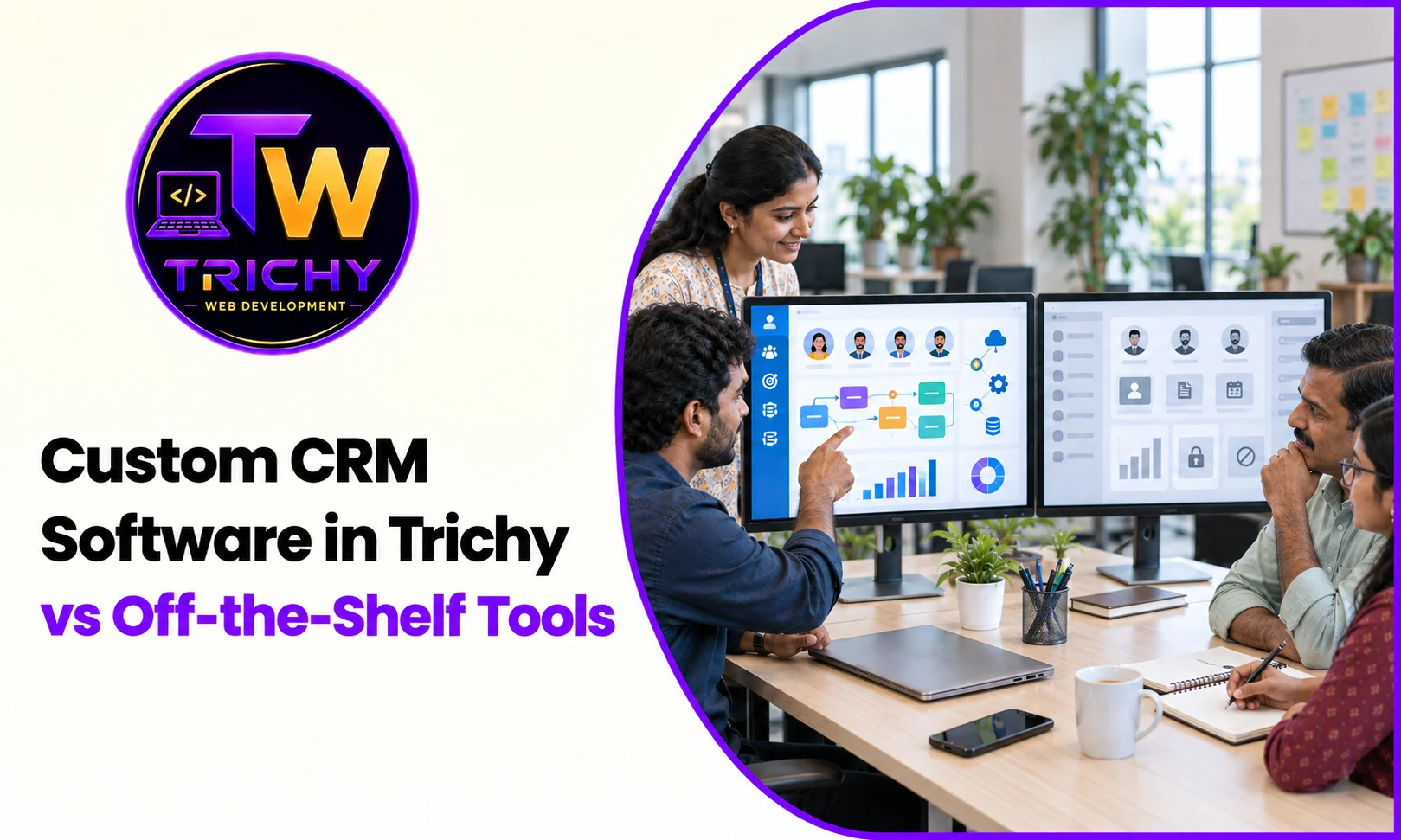
Off-the-shelf CRM platforms can provide useful features for managing contacts, leads, sales pipelines, and customer interactions. However, businesses with specialized workflows may eventually encounter limitations involving customization, integrations, reporting, automation, user roles, or data structures.
This is where custom CRM software in Trichy becomes relevant. Instead of adapting business processes to a fixed platform, a custom CRM can be designed around the organization's actual customer journey and operational requirements.
For some businesses, a standard CRM remains sufficient. For others, tailored CRM solutions in Trichy can provide a closer fit between technology and the way the business operates.
Quick Answer: Why Choose Custom CRM Over an Off-the-Shelf CRM?
Businesses may consider custom CRM software when a standard CRM cannot efficiently support their workflows, integrations, reporting requirements, user roles, or industry-specific processes.
A custom CRM can be designed around the business's existing processes, allowing organizations to decide which modules, automations, dashboards, permissions, and integrations they actually need.
However, customization also involves greater development responsibility and upfront investment, so businesses should compare the long-term value against the capabilities and cost of available off-the-shelf platforms.
Introduction
CRM software has become an important part of customer management for many growing businesses.
An off-the-shelf CRM can make it easier to organize contacts, track leads, manage sales opportunities, schedule follow-ups, and generate reports. For businesses with relatively standard sales processes, these capabilities may be enough.
The situation changes when a business has a highly specific workflow.
A real estate company may need to connect enquiries with properties, site visits, negotiations, bookings, and documentation.
A manufacturing company may need dealer management, quotations, product information, sales activities, and ERP integration.
A training organization may need enquiry management, counselling, course selection, registration, payment tracking, and batch allocation.
Trying to force these processes into a generic CRM can create workarounds.
This is one reason businesses explore custom CRM development in Trichy.
Instead of asking employees to adapt completely to the software, the software can be designed around the business process.
What Is Custom CRM Software?
Custom CRM software is a customer relationship management system developed specifically for the requirements of an organization.
Unlike a standard CRM platform where the core functionality is largely predetermined, a custom CRM can be designed around requirements such as:
-
Business-specific workflows.
-
Custom data fields.
-
Industry-specific modules.
-
Unique sales processes.
-
Custom dashboards.
-
Specialized user roles.
-
Business-specific automation.
-
Custom integrations.
-
Organization-specific reports.
The objective is not to build a CRM simply because customization is possible.
The objective is to solve business problems that a standard system cannot address efficiently.
Off-the-Shelf CRM vs Custom CRM
Before discussing why businesses choose customization, it is important to understand the difference.
|
Factor |
Off-the-Shelf CRM |
Custom CRM |
|
Initial deployment |
Usually faster |
Requires development |
|
Standard features |
Usually extensive |
Selected according to requirements |
|
Custom workflows |
Depends on platform |
Can be developed specifically |
|
Integrations |
Depends on available connectors/APIs |
Can be built around required systems |
|
User interface |
Platform-defined with customization options |
Designed around business users |
|
Reporting |
Standard and configurable |
Can be built for specific requirements |
|
Upfront cost |
Often lower |
Usually higher |
|
Long-term flexibility |
Depends on vendor |
High, subject to architecture |
|
Maintenance |
Usually provider-managed |
Business/development team responsibility |
|
Vendor dependency |
Usually higher |
Can be lower, depending on implementation |
Neither model is universally better.
The appropriate choice depends on the organization's processes, budget, technical requirements, growth plans, and willingness to manage a custom system.
Why Trichy Businesses May Consider Custom CRM Software
1. Their Sales Process Does Not Fit a Standard Pipeline
A typical CRM might offer stages such as:
New Lead → Contacted → Qualified → Proposal → Won
But not every business operates this way.
A property business may need:
Enquiry → Property Matching → Site Visit → Negotiation → Booking → Documentation
A service business may need:
Enquiry → Requirement Assessment → Quotation → Scheduling → Service → Feedback
When the actual process is significantly different from the default CRM workflow, customization may reduce unnecessary workarounds.
2. They Need Tailored CRM Workflows
Tailored CRM solutions in Trichy can be designed around the exact sequence of activities a business follows.
This can include:
-
Custom lead stages.
-
Conditional workflows.
-
Department-specific processes.
-
Approval steps.
-
Automated task creation.
-
Custom notifications.
-
Industry-specific fields.
-
Business-specific customer statuses.
For example, when a sales employee changes a lead to “Quotation Sent,” a customized CRM could automatically create a follow-up task and notify the relevant manager.
The usefulness comes from connecting the workflow to an actual business process.
3. Existing Software Needs to Work Together
Many businesses already use multiple digital systems.
A CRM may need to communicate with:
-
Websites.
-
ERP software.
-
Accounting systems.
-
E-commerce platforms.
-
Payment gateways.
-
Email systems.
-
Communication platforms.
-
Inventory systems.
-
Marketing platforms.
-
Internal applications.
An off-the-shelf CRM may support some integrations through existing connectors.
However, businesses with specialized systems may need custom API integrations.
Custom CRM development in Trichy can incorporate those integration requirements into the application's architecture.
4. They Need Business-Specific Reporting
Standard CRM dashboards may provide useful reports such as:
-
Leads generated.
-
Deals won.
-
Sales value.
-
Conversion rate.
-
Employee activity.
But management may need more specific information.
For example, a business may want to know:
-
Which marketing source generates the highest-value customers?
-
How long does each customer stage take?
-
Which products generate the most enquiries?
-
Which branches have the highest conversion?
-
How many quotations are pending approval?
-
Which customers have not been contacted recently?
A custom reporting system can be designed around these business questions.
5. They Want More Control Over User Roles
Different employees may require different levels of access.
For example:
Sales Executive: Assigned leads and customer activities.
Sales Manager: Team pipeline and performance.
Finance Team: Payment-related information.
Customer Support: Customer history and service requests.
Administrator: System-wide configuration.
A customized permission model can reflect the organization's structure.
This is particularly useful when access requirements are more complex than standard CRM roles.
6. They Want to Remove Unnecessary Features
More features do not always mean a better user experience.
An off-the-shelf CRM may contain dozens of modules that a particular business does not use.
Employees may then have to navigate screens, menus, fields, and options that are irrelevant to their daily work.
A custom CRM can focus on the workflows that employees actually need.
This can create a simpler interface and potentially improve adoption.
The goal should be to build enough functionality to solve the business problem without introducing unnecessary complexity.
7. Their Data Structure Is Unique
Every business organizes customer information differently.
A standard CRM may provide fields for:
-
Name.
-
Email.
-
Phone number.
-
Company.
-
Lead source.
-
Sales stage.
But specialized businesses may need additional relationships.
For example, a real estate CRM may need to connect:
Customer → Property → Site Visit → Negotiation → Booking
A manufacturing CRM may need:
Customer → Dealer → Product → Quotation → Order
A training CRM may need:
Lead → Course → Counselling → Registration → Batch
Custom data structures can represent these relationships more directly.
8. They Need Custom Automation
Automation is often one of the strongest reasons for CRM customization.
Businesses may want automated workflows such as:
New Website Enquiry → Create Lead → Assign Salesperson → Send Notification → Create Follow-Up → Track Response
Or:
Quotation Approved → Notify Sales Team → Create Customer Record → Trigger Internal Process
The exact automation should reflect the business's workflow.
Automation should reduce repetitive work rather than make the process harder to understand.
9. They Want Their CRM to Grow With the Business
A CRM should support future requirements without becoming difficult to manage.
As a business grows, it may need:
-
More users.
-
Multiple branches.
-
New departments.
-
Additional products.
-
New sales pipelines.
-
Mobile applications.
-
Customer portals.
-
Advanced reporting.
-
Additional integrations.
-
More automation.
Personalized CRM systems in Trichy can be architected with these future requirements in mind.
However, future-proofing should not mean building every possible feature from the beginning.
A phased approach is often more practical.
10. They Need Better Integration With Internal Operations
Customer management does not happen independently from the rest of the business.
A customer enquiry may eventually lead to:
Lead → Quotation → Order → Payment → Delivery → Support
If each stage exists in a different system, employees may need to repeatedly enter the same information.
A customized CRM can potentially connect these stages with ERP, accounting, inventory, or other business systems.
This can create a more continuous flow of information.
When Off-the-Shelf CRM May Still Be the Better Fit
Custom CRM is not automatically the right answer.
An off-the-shelf platform may be appropriate when:
-
The business has a relatively standard sales process.
-
Existing CRM features meet most requirements.
-
Required integrations are already supported.
-
The business wants quick implementation.
-
The available budget is limited.
-
Internal customization requirements are relatively small.
-
The business prefers vendor-managed updates and infrastructure.
For example, a small sales team with a straightforward lead-to-sale process may not need a fully custom platform.
Customization should solve a genuine requirement rather than become a technology project without a clear business benefit.
When Custom CRM Development Becomes More Relevant
Custom CRM development may deserve consideration when several of these conditions exist:
-
Existing CRM workflows require frequent workarounds.
-
Important business processes cannot be represented effectively.
-
Critical integrations are unavailable.
-
Reporting requirements are highly specific.
-
Multiple departments need interconnected workflows.
-
The business has complex permission requirements.
-
Manual data entry is creating operational problems.
-
The organization expects significant process changes or growth.
-
CRM data needs to connect with internal applications.
-
The business needs greater control over the application's functionality.
The more significant these requirements become, the more useful a customized approach may be.
A Practical Framework: The F-I-T CRM Test
Businesses can use the F-I-T framework before deciding whether customization is necessary.
F — Fit
Does the existing CRM naturally fit the business workflow?
If employees constantly need workarounds, the fit may be limited.
I — Integration
Can the CRM connect with the systems that the business already depends on?
Consider websites, ERP, accounting, inventory, payments, APIs, and communication systems.
T — Total Value
Would customization create enough operational value to justify development, maintenance, and ownership costs?
This framework prevents businesses from choosing custom development simply because it offers more features.
How CRM Customization Services Can Help
CRM customization services in Trichy can range from relatively small modifications to complete CRM development.
Examples include:
Custom Fields
Adding fields that are specific to a business's customer or sales process.
Custom Modules
Creating modules for properties, projects, service requests, quotations, subscriptions, or other business-specific entities.
Workflow Customization
Changing lead stages and business processes to reflect actual operations.
Dashboard Customization
Creating management dashboards based on business-specific KPIs.
API Integration
Connecting CRM data with external systems.
User Permission Customization
Creating role-based access according to organizational responsibilities.
Automation
Creating automated tasks, notifications, approvals, and data updates.
Not every business needs all of these services.
How Bespoke CRM Software Can Improve Daily Operations
Bespoke CRM software in Trichy can be designed around the way employees actually work.
Imagine a sales employee receiving a new enquiry.
Instead of:
Check Email → Copy Data → Open Spreadsheet → Update Status → Set Phone Reminder → Inform Manager
the workflow could become:
New Enquiry → CRM Lead Created → Lead Assigned → Follow-Up Scheduled → Status Updated
This does not mean every business process should be automated.
It demonstrates how software can remove unnecessary administrative steps when the workflow has been properly mapped.
Industry Examples in Trichy
Real Estate
A custom CRM can connect customer enquiries with property preferences, site visits, negotiations, bookings, and follow-ups.
Manufacturing
Manufacturers can manage dealer enquiries, B2B leads, quotations, product information, customer interactions, and sales pipelines.
Education and Training
Training organizations can manage course enquiries, counselling, registrations, payments, batch allocation, and follow-up activities.
Healthcare and Services
Service-oriented organizations can manage enquiries, appointments, customer history, service requests, and communication.
Travel
Travel businesses can manage trip enquiries, customer preferences, quotations, booking follow-ups, and repeat customer information.
These examples illustrate why a CRM's usefulness often depends on how closely its workflows match the organization's actual operations.
Custom CRM Development Process
A structured custom CRM development in Trichy project can follow several stages.
1. Business Discovery
Understand the organization's customer journey, departments, workflows, and operational problems.
2. Requirement Mapping
Document the required modules, fields, roles, automation, reports, and integrations.
3. Process Design
Translate business workflows into CRM processes and system rules.
4. UI/UX Design
Design interfaces that make common employee tasks straightforward.
5. Development
Build the CRM modules, database structure, APIs, workflows, and business logic.
6. Integration
Connect the CRM with required websites, applications, APIs, or business systems.
7. Testing
Test workflows, permissions, integrations, data accuracy, performance, and security.
8. Data Migration
Clean and migrate existing customer information where required.
9. Deployment
Release the CRM in a controlled environment and prepare users.
10. Training and Support
Train employees and continuously improve the system based on actual usage.
Common Mistakes Businesses Make When Choosing Custom CRM
Building Before Understanding the Workflow
Starting development without mapping the customer journey can result in a technically functional but operationally unsuitable system.
Trying to Recreate Every Existing Feature
A business does not need to reproduce every feature found in large CRM platforms.
The system should focus on genuine requirements.
Ignoring User Adoption
A CRM is useful only when employees actually use it consistently.
Underestimating Data Migration
Existing customer data may contain duplicates, inconsistent formats, incomplete records, and outdated information.
Neglecting Integration Planning
Integrations can affect architecture, security, testing, and development timelines.
Treating Maintenance as an Afterthought
Custom software requires ongoing updates, security maintenance, bug fixes, monitoring, and improvements.
Focusing Only on Development Cost
Businesses should consider the total cost of ownership, including development, hosting, support, maintenance, training, and future enhancements.
How to Calculate Whether Custom CRM Is Worth It
A useful comparison should consider both costs and operational benefits.
Current Costs
Identify:
-
CRM subscriptions.
-
Manual administrative work.
-
Duplicate data entry.
-
Missed follow-ups.
-
Reporting effort.
-
Integration workarounds.
-
Existing software limitations.
Expected Benefits
Consider:
-
Time saved.
-
Better lead management.
-
Faster follow-ups.
-
Reduced duplicate data.
-
Improved reporting.
-
Better workflow visibility.
-
Reduced manual work.
-
Integration improvements.
-
Ability to support future processes.
The objective is not to prove that custom CRM is cheaper.
The objective is to determine whether the additional investment produces enough operational value.
Custom CRM Software for Trichy Businesses
Businesses in Trichy operate across a wide range of industries, and their customer-management processes can differ significantly.
A real estate company may need property and site-visit workflows.
A manufacturer may need dealer and quotation management.
A training company may need enquiry-to-registration tracking.
A service provider may need customer requests and scheduling.
A growing digital business may need CRM integration with websites, marketing systems, and applications.
For businesses exploring CRM customization services in Trichy, local development support can be useful when requirements involve business-specific workflows and integrations. However, the development partner should still be evaluated based on technical capability, process understanding, security, scalability, documentation, and long-term support.
Conclusion
Off-the-shelf CRM platforms can provide a strong starting point for customer management, but they are not designed around the unique workflow of every business.
When employees constantly adapt their processes to fit software, rely on spreadsheets to fill gaps, manually transfer information between systems, or struggle to generate the reports they actually need, it may be time to evaluate a more tailored approach.
Custom CRM software in Trichy can allow businesses to design workflows, data structures, integrations, automation, dashboards, and permissions around their actual operations.
At the same time, customization comes with development, maintenance, security, and ownership responsibilities. It should therefore be considered when the business requirements justify that additional investment.
The most important question is not whether custom CRM is more advanced than an off-the-shelf tool. It is whether the CRM fits the way the business sells, serves, communicates with, and retains its customers.
When the software and business process work together rather than against each other, CRM becomes more than a customer database—it becomes part of the organization's operating system.